NFT Membership Subscription Tutorial: Minting, Expiry, and Renewal Patterns
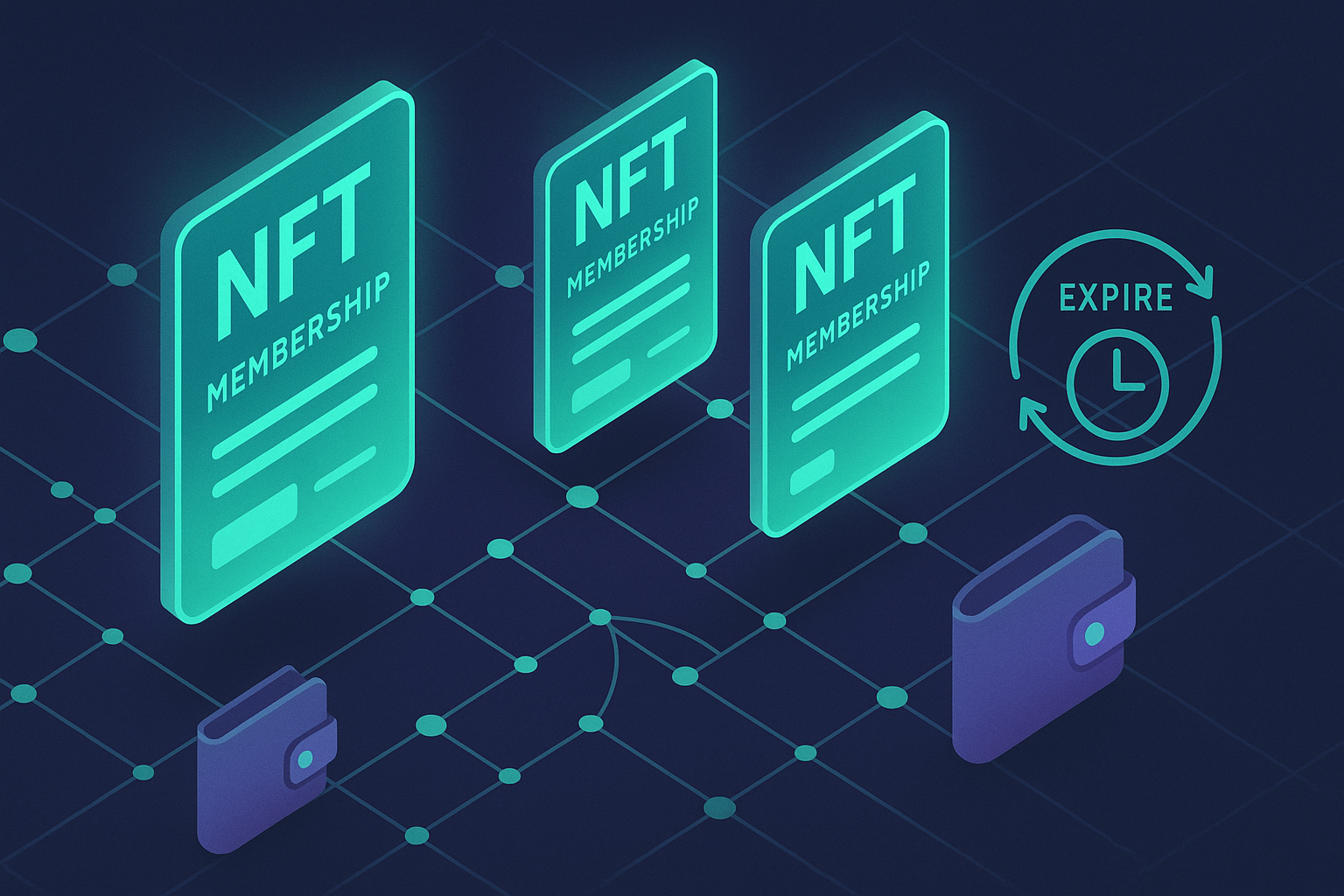
Selling recurring access to content or community without relying on a centralized platform is increasingly practical. This NFT membership subscription tutorial covers exactly that: turning blockchain tokens into time-bound access passes using current tooling. We'll walk through membership NFT standards, minting patterns, expiry and renewal mechanics, and the tools that make it all manageable in 2026.
What Is a Membership NFT?
A membership NFT is a token — typically ERC-721 or ERC-1155 on an EVM-compatible chain — whose on-chain state controls whether its holder can access a service, community, or piece of content. Unlike a static collectible, the token's utility is dynamic: a smart contract checks the token's status before granting access, and that status changes over time based on payment or inactivity.
ERC-721 mints one unique token per subscriber. Each token has its own ID, making it easy to track individual memberships, assign different tiers, and attach metadata that changes as the subscription evolves. The trade-off is higher gas per mint when onboarding large audiences.
ERC-1155 treats identical subscription tiers as fungible within a tier class. Minting a batch of "Silver Member" tokens costs far less gas than minting 500 individual ERC-721s, making it the practical choice for creators with large audiences or multiple standardized tiers.
ERC-4885 is a proposal designed specifically for subscription NFTs: a subscriber deposits ERC-20 tokens and receives an NFT whose balance decreases linearly, disabling access once it hits zero. Not yet universally adopted, but it codifies patterns many teams already implement manually.
Minting: How Subscribers Get Their Token
The minting flow is the entry point of the subscription lifecycle. There are two dominant patterns:
Mint-on-payment: When a subscriber pays (in USDC, ETH, or another token), the contract immediately mints a new NFT to their wallet and sets an expiresAt timestamp. The contract's checkAccess(tokenId) function returns true until that timestamp passes. This is the simplest model — no off-chain state required for access verification.
Lazy/off-chain mint with on-chain settlement: Payment is processed off-chain (card, bank transfer, or a hosted USDC flow), and the NFT is minted once the payment is confirmed. This pattern is friendlier for subscribers who aren't yet comfortable interacting with a wallet directly. Platforms like Crossmint and tools built on Unlock Protocol support this hybrid checkout. The subscriber ends up with an NFT in a custodial or non-custodial wallet, but the payment UX looks familiar.
For most independent creators, the lazy-mint pattern reduces friction significantly. The subscriber doesn't need to sign a transaction or pay gas; those concerns are abstracted away.
Expiry and Renewal Patterns
Getting expiry right is the most important design decision in a membership NFT system. Choose the wrong pattern and you'll fight your own contract at renewal time.
Timestamp-based expiry (recommended for most use cases): The contract stores an expiresAt field per token. Access checks compare block.timestamp to that value. On renewal, the owner (or an authorized operator) calls an extend(tokenId, duration) function that pushes the timestamp forward. The token stays in the subscriber's wallet the whole time — no burn, no re-mint. Metadata can reflect the new expiry date dynamically via an on-chain or off-chain metadata URI.
Burn-and-remint: The expired token is burned and a new one is minted on renewal. Useful for on-chain proof of consecutive subscription periods, but every renewal costs gas, and subscribers lose token history if they lapse.
Burn-on-use: The NFT is consumed the moment it grants access — more common for event tickets than recurring memberships.
For automated renewal, Chainlink Automation (formerly Chainlink Keepers) can monitor expiring tokens and trigger on-chain actions — either disabling the token automatically or pinging an off-chain webhook to start the renewal billing flow. This is the cleanest solution for hands-off recurring billing where subscribers have pre-authorized a recurring USDC pull.
Tooling: What to Actually Use
You don't need to write a subscription contract from scratch in 2026. Several battle-tested options exist:
Unlock Protocol is the most complete open-source toolkit for membership NFTs. Its PublicLock contract handles minting, expiry timestamps, pricing in ERC-20 tokens or ETH, and on-chain access checks. Deploy a Lock per tier, set price and duration, and Unlock handles the rest — with native USDC support on Polygon and a no-code dashboard.
Thirdweb provides audited, deployable NFT contract templates with a JavaScript SDK and account abstraction, meaning subscribers can get a wallet without knowing what one is.
Crossmint focuses on the minting UX: credit-card checkout for NFTs, custodial wallets for non-crypto-native subscribers, and webhook-based minting triggers. Pair it with an Unlock Protocol contract and you get a full no-wallet-required membership system.
For on-chain access verification in a Next.js app:
// Returns true only if the address holds a non-expired key
const isActiveMember = await lockContract.getHasValidKey(walletAddress);
One call, no custom access logic needed.
If you'd rather skip smart contract deployment entirely, CryptoScribe is a hosted non-custodial layer where creators set tiers and prices, subscribers pay USDC directly to the creator's wallet, and access is managed via webhook-driven server state.
For token-gating mechanics — wallet ownership verification, SIWE auth, and Next.js middleware — see /blog/token-gated-subscription-crypto-setup.
NFT Memberships vs. Plain Token Gating: The Real Trade-offs
NFT memberships give you programmable, time-bound access. Plain token gating is binary — you hold the token or you don't. Here's how they compare:
Advantages of membership NFTs:
- Built-in expiry and renewal logic lives on-chain, not in your database
- Each subscriber's access is individually addressable — you can pause, extend, or upgrade a single token without touching others
- The NFT itself can carry metadata (tier, join date, renewal count) that third-party apps can read
- Transferability is configurable — you can make membership tokens soulbound (non-transferable) or tradeable
Advantages of plain token gating:
- Lower complexity — no contract deployment, no expiry management
- Works with tokens subscribers may already hold
- Faster to prototype, especially for community-access use cases
The honest cons of NFT memberships:
- Gas costs per mint/renewal, even on L2s, add friction that plain subscriptions don't have
- Wallet onboarding is still a barrier for non-crypto audiences (though tooling is improving)
- Smart contract bugs are irreversible; audits add cost and time
- Tax and regulatory treatment of NFT sales varies by jurisdiction — consult a qualified tax professional before structuring revenue around NFT issuance
Practical Takeaways
- Start with ERC-721 + timestamp expiry if you need individual tracking per subscriber; use ERC-1155 batch minting if you're managing hundreds of identical-tier memberships
- Use Unlock Protocol as your contract layer — it's audited, actively maintained, and supports USDC on Polygon out of the box
- Abstract the wallet with Thirdweb or Crossmint for non-crypto audiences; the NFT can live in a managed wallet until subscribers want to take custody
- Automate renewals with Chainlink Automation or webhook-triggered minting tied to a recurring payment processor
- Make expiry visible: show subscribers their renewal date, what happens to their access on lapse, and what payment methods you accept — predictability reduces churn
- Get legal and tax advice before launch; NFT sales may trigger different obligations than software subscriptions depending on your jurisdiction
The infrastructure for NFT membership subscriptions has matured considerably. What required a custom Solidity deployment and a backend access-control service two years ago can now be assembled from audited contracts and no-code dashboards in an afternoon — the challenge is picking the right combination for your audience and use case.
Ready to earn in USDC, to your own wallet?